Wednesday, 11 April 2012

Business Information Technology - Week Six Questions

What is information architecture and what is information infrastructure and how do they differ and how do they relate to each other?

Information architecture identifies where and how important information, such as customer records, is maintained and secured. Information Infrastructure includes the hardware, software and telecommunications equipment that, when combined, provides the underlying foundation to support the organisations goals. They differ in the way that information architecture only deals with the information that it is presented with and is responsible for how it is maintained and secured where as; information infrastructure deals with equipment perspective side that provides the underlying foundation to support the organisational goals. Each relates to one another in the way that they are both important in regards to the information that an organisation has within the business and equipment used to ensure everything is supported towards its goals.
Describe how an organisation can implement a solid information architecture
The three primary areas of information architecture are:
1)      Backup and recovery; an organisation should choose a backup and recovery strategy that is in line with its business goals. If the organisation deals with large volumes of critical information, it will require daily backups, perhaps even hourly backups, to storage servers.

2)      Disaster recovery; Considers the location of the backup information. Many organisations store backup information in an off-site facility, StorageTek, a worldwide technology company that delivers a broad range of data storage offerings, specialises in providing off-site information storage and disaster recovery solutions.

3)      Information security; Security professional are under increasing pressure to do the job correctly and cost effectively as networks extend beyond organisations to remote users, partners and customers, and to mobile phone, PDAs and other mobile devices.
List and describe the five requirement characteristics of infrastructure architecture.
1)      Flexibility – Systems must be flexible enough to meet all types of business changes. When the company starts growing and performing business in new countries, the system will already have the flexibility to handle multiple currencies and languages.

2)      Scalability – Refers to how well a system can adapt to increased demands.

3)      Reliability- Ensures all systems are functioning correctly and providing accurate information. Reliability is another term for accuracy when discussing the correctness of systems within the context of efficiency IT metrics.

4)      Availability – Addresses when systems can be accessed by users.

5)      Performance- Measures how quickly a system performs a certain process or transaction (in terms of efficiency IT metrics of both speed and throughput).
Describe the business value in deploying a service oriented architecture

Service oriented Architecture, with its loosely coupled nature, allows enterprises to plug in new services or upgrade existing services in a granular fashion. This enables businesses to address the new business requirements, provides the option to make the services consumable across different channels and exposes the existing enterprise and legacy applications as services, thereby safeguarding existing IT infrastructure investments.
What is an event?
Events are the eyes and ears of the business expressed in technology – they detect threats and opportunities and alert those who can act on the information.
What is a service?
Services are more like software products than they are coding projects. They must appeal to a broad audience, and they need to be reusable if they are going to have an impact on productivity.

Business Information Technology - Week Five Questions


Explain the ethical issues surrounding information technology
Ethics is a system of moral principle that considers our actions from right and wrong. Ethical issues surrounding informational technology consist of the following

-Intellectual property: collection of rights that protect creative and intellectual effort.
-Copyright: Exclusive right to do certain acts with intangible property
-Fair use doctrine: In certain situations, it is legal to use copyrighted material
-Pirated software: unauthorized use, duplicate, distribution, or sale of copyrighted software.
-Counterfeit software: software that is manufactured to look like the real thing and sold as such
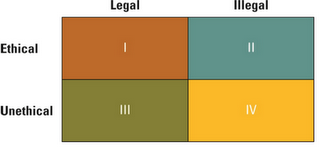
 Describe a situation involving technology that is ethical but illegal
A situation involving technology that is ethical but illegal may be; when one purchases a program for their computer and creates a backup copy in case of any damage or loss of the original. Even though it states that copies of the program are illegal and should not be made the backing up of a program for your own use is not cheating the procedures of customers. This situation is most definitely considered unethical if the copy is being made multiple times to sell over the internet or at a market then the issue becomes both unethical an illegal.

Describe and explain one of the computer use policies that a company might employ
A company may employ an ‘internet use policy’ to contain general principles to guide the proper use of the internet. This has some unique aspects that make it a good candidate for its own policy. Implementing this policy means that all employees are encouraged to use the internet responsibly. These policies include:
1. Describe available internet services
2. Define the purpose and restriction of Internet access
3. Complements the ethical computer use policy
4. Describes user responsibilities
5. States the ramification for violations

What are the 5 main technology security risks?
1)      Human Error: after complete recheck to find any mistakes

2)      Natural Disasters: regularly save data as back up and in alternative area

3)      Technical Failures: install a trustworthy spyware fighter and regularly save data in a separate

4)      Deliberate Acts: constantly monitor the employees actions when working in the firm

5)      Management Failure: Ensure proper training and procedures in the workplace to new employees

Outline one way to reduce risk
One way to reduce risk may include ‘The second line of defence technology.’ Organisations can deploy numerous technologies to prevent information security breaches. When determining which types of technologies to invest in, it helps to understand the three primary information security areas:
1 ) authentication and authorisation
2) Prevention and resistance
3) Detection and response

What is a disaster recovery plan, what strategies might a firm employ?
A disaster recovery plan examines those situations that prevent you from carrying on business. Disaster Recovery is a process of regaining access to computer systems and data after a disaster has taken place. Careful planning helps your business get back to normal operations as quickly as possible. A firm might employ the following strategies.

-        location of backup data: offsite data kept in order

-        Develop information security policies

-        Communicate the information security policies

-        Identify critical information assets and risks

-        Obtain stakeholder support

Saturday, 24 March 2012

Business Information Technology - Week Four Questions

1.  What is Web 2.0, how does it differ from 1.0?
Web 2.0 is a set of economic, social and technology trends that collectively form the basis for the next generation of the internet – a more mature, distinctive medium characterised by user participation, openness and network effects. 2.0 is a more innovative, faster and modern version of 1.0.

2. How could a web 2.0 technology be used in business?
According to one commentator, ‘Web 2.0 is the business revolution in the computer industry caused by the move to the internet as platform, and an attempt to understand the rules for success on that new platform. It has been used in business as a transformative force that is propelling companies across all industries towards a new way of doing business


3.  What is eBusiness, how does it differ from eCommerce?
EBusiness, derived from e-commerce, is the conducting of business on the Internet, including buying and selling, serving customers and collaborating with business partners. The primary difference between e-commerce and e-business is that e-business also refers to online exchanges of information, such as manufacturer allowing its suppliers to monitor production schedules or a financial institution allowing its customers to review their banking, credit car and mortgage accounts.
4.  What is pure and partial eCommerce? 
        Pure vs. Partial EC
            --The product can be physical or digital.
            --The process can be physical or digital.
            --The delivery agent can be physical or digital.
        Brick-and-mortar organizations are purely physical organizations.
        Virtual organizations are companies that are engaged only in EC. (Also called pure play)
        Click-and-mortar organizations are those that conduct some e-commerce activities, yet their business is primarily done in the physical world. i.e. partial EC.

5.  List and describe the various eBusiness models
E-business models are an approach to conducting electronic business on the Internet. These transactions take place between two main entities- businesses and consumers. The e-business models are stated below:
  • Business-to-business (B2B) Applies to businesses buying from and selling to each other over the internet.
  • Business-to-consumer (B2C) Applies to any business that sells its products or services to consumers over the internet
  • Consumer-to-business (C2B) Applies to any consumer that sells a product or service to a business over the internet
  • Consumer-to-Consumer (C2C) Applies to sites primarily offering goods and services to assist consumers interacting with each other over the internet.

6.  List and describe the major B2B marketplace models? 
Business-to-business (B2B) applies to businesses buying from and selling to each other over the internet. Electronic marketplaces, or e-marketplaces, are interactive business communities providing a central market where multiple buyers and sellers can engage in e-business activities. Each presents structures for conducting commercial exchange, consolidating supply chains, and creating new sales channels. Their primary goal is to increase market efficiency by tightening and automating the relationship between buyers and sellers. Those existing e-marketplaces allow access to various mechanisms in which to buy and sell a range of things, from services to direct materials. These transactions are generally conducted via extranet – (individual companies’ intranets connected together using high levels of network security (often using a virtual private network, or VPN).

Wednesday, 14 March 2012

Business Information Technology - Week Three Questions

(TPS) Transaction processing systems and (DSS) decision support systems are two of three common types of decision making information systems used in organisations today. Both systems use different models to assist in decision making, problem solving and opportunity capturing. An example of these systems in business is as follows. TPS – Analysts and DSS- Managers.
2)      Describe three quantitative models typically used by decision support systems
A decision support system (DSS) models information to support managers and business professionals during the decision making process. The three quantitative models used by DSS include:
-          Sensitivity analysis: The study of the impact that changes in one (or more) parts of the model. Users change the value of one variable repeatedly and observe the resulting changes in other variables.
-          What if analysis: Checks the impact of a change in an assumption on the proposed solution. Users repeat this analysis until they understand the effects of various situations.
-          Goal-Seeking analysis: Finds the inputs necessary to achieve a goal. Instead of observing how changes in a variable affect other variables as in what-if analysis, goal-seeking analysis sets a target value or a goal for a variable and then repeatedly changes other variables until the target value is achieved.

3)      Describe a business processes and their importance to an organisation, outline and examine how they are used
A business process is a standardised set of activities that accomplish a specific task such as processing a customer’s order. The importance of a business process is significantly relevant to how the business runs and its outcome of success. Business processes transform a set of inputs into a set of outputs; otherwise known as goods and services for another person or process by using people and tools. Organisations are only as effective as their business process and by developing this it can logically help an organisation achieve its goals.

4)      Compare business process improvement and business process re-engineering
Business Process Improvement attempts to understand and measure the current process and make performance improvements accordingly. Whereas Business Process re-engineering is the analysis and redesign of works from within and between enterprises. Unlike process Improvement, this relies on a different school of thought.


5)      Describe the importance of business process modelling(or mapping) and business process models
Business Process Modelling (or mapping) is the activity of creating a detailed flowchart or process map of a work process, showing its inputs, tasks and activities in a structured sequence. Business process models are a graphic description of a process, showing the sequence of process tasks, which is developed for a specific purpose and from a selected viewpoint. Each process exposes process detail gradually and in a controlled manner and provides a powerful analysis and consistent design vocabulary.


Saturday, 10 March 2012

Business Information Technology - Week Two Questions

Explain the role of information technology’s role in business
Information technology is everywhere and it enables some businesses to differentiate themselves from competitors to gain competitive advantage. It works to maximise the efficiency of IT operations so that the business can focus on their resources on providing value for the business. Further more, it allocates the business with information and communication thus creating positive effectiveness.


What are efficiency and effectiveness metrics? (Provide examples)
-          Efficiency IT metrics measures the performance of the IT system itself including throughput, speed, and availability. Getting the most from each source. Some include: Throughput, transaction speed, system availability, web traffic, response time, and information accuracy. The main focus of efficiency is based of technology and how it operates. Examples of Efficiency IT metrics are as follows: 40% of equipment (on average) is in Development/Test, vs. Production
-          Data Centre greenhouse emissions will surpass that or airlines by 2020
-          Server utilization is still low; up to 30% of servers are "dead"; average cooling utilization is only 50%
-          Effectiveness IT metrics measures the impact IT has on business processes and activities including customer satisfaction, conversion rates, and sell through increases. Setting the right goals and seeing they are accomplished. The main focus of efficiency is based around an organisations goals, strategies and objectives. Some include: Usability, customer satisfaction, conversion rates and financial. Examples of effectiveness IT metrics are as follows:
-          Mean Time to Repair: How long it takes to resolve an outage.
-          Server to System Administration Ratio: Number of servers that can be handled by an administrator (high performers can handle about 125 servers.. while medium and low performers can handle about 25)
-          First Fix Rate: The percentage of incidents that are correctly repaired the first time.
-          Change Success Rate: Percent of changes that are successfully deployed without creating an incident.


What does Porters give forces Model attempt to explain? How does the internet affect the model?

1) Buyer Power
2) Supplier Power
3) Threat of substitute products or services
4) Threat of new entrants
5) Rivalry among existing competitors

These forces attempt to help companies identify potential opportunities while deterring potential rivals. It helps to determine the relative attractiveness of an industry. Information technology increases competition as availability of information increases, thus the more the internet displays information technology, the more competitive the market will become for the business.

Describe the relationship between processes and value chains

-  The Value chain enables a firm to evaluate activities that add value to a firm’s products and services used within the organisation. It views an organisation as a series of processes, each of which adds value to the product or service.  In comparison to Business Processes which is a standardised set of activities that accomplish a specific task. The relationship between the two are branched down and connected from the value creation which is the result of effective business processes and efficient value chains. Both enable support activities and can decrease the threat of new entrants; moreover improving primary activities can decrease the threat of substitutes.